Concrete Carbonation Test Chamber Manufacturer,Supplier and Exporter in India
Product Code : TVT-CTE-10532
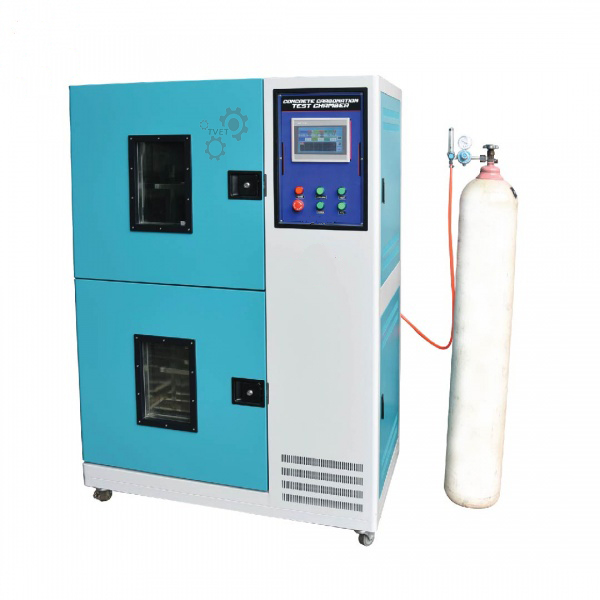
The Concrete Carbonation Test Chamber maintains the controlled temperature, humidity and carbon dioxide concentration conditions needed to accelerate and study the carbonation depth of concrete specimens, supporting long-term durability assessment of cement-based materials.
How It Works
Concrete specimens are placed inside the sealed chamber, which maintains an elevated CO? concentration together with controlled temperature and humidity; over the exposure period, carbon dioxide diffuses into the concrete and reacts with its hydration products, and the resulting carbonation front (revealed by a phenolphthalein indicator on a freshly broken/cut face) is measured as the carbonation depth at set exposure intervals.
Technical Specifications
| Parameter | Specification |
|---|---|
| Temperature Range | 15°C – 30°C |
| Temperature Uniformity | ±1°C |
| Humidity Range | 50% – 90% |
| CO? Concentration | 0 – 20% ±3% |
| Precision | ±1% |
| Voltage | 240V, 50/60Hz, 1Ph |
| Chamber Space | 645(W) x 450(D) x 1290(H) mm |
| Overall Dimension | 1215(W) x 630(D) x 1690(H) mm |
| Approx. Weight | 165 kg |
Applications
Used for accelerated carbonation durability testing of concrete and cement-based materials per RILEM CPC-18 (Measurement of hardened concrete carbonation depth) and EN 13295 (determination of resistance to carbonation), an important long-term durability indicator for reinforced concrete exposed to atmospheric CO?.
Related Products & Category
Listed under Concrete Testing Equipments. Related products: Rapid Chloride Permeability Tester and Digimatic Concrete Impermeability Apparatus.
Frequently Asked Questions
What does the carbonation test measure?
It measures how far carbon dioxide has penetrated and reacted with a concrete specimen over a controlled exposure period, expressed as the carbonation depth — a key long-term durability indicator for reinforced concrete.
What CO2 concentration does the chamber maintain?
0 to 20% ±3%, accelerating the natural carbonation process compared with ambient atmospheric CO2 levels.
Why are temperature and humidity controlled during the test?
Carbonation rate is sensitive to both temperature and relative humidity, so maintaining them within a controlled range (15-30°C, 50-90% RH) ensures repeatable, comparable results between specimens and test batches.
Request a Quote
To get a quotation for the Concrete Carbonation Test Chamber, tell us the test standard you work to, the quantity, your power supply (voltage and phase) and the delivery location. Request a quote from Tvet Equipments.
Last updated: September 2026
.jpg)